Silver has always carried a unique kind of magic. It is beautiful enough to become jewelry, practical enough to power modern technology, and valuable enough to attract investors when financial markets become uncertain.
But silver is not a metal that simply sits still.
Its price can rise sharply, fall unexpectedly, and react to everything from inflation and interest rates to industrial demand, currency movements, geopolitical tension, and investor sentiment. For anyone following the precious-metals market, knowing the current silver price is only the beginning. Understanding why that price moves is where the real story begins.
This is where Fintechzoom.com Silver Price becomes an interesting resource for people who want to follow silver prices, market trends, charts, and related financial information in one place.
Whether you are a first-time investor, a precious-metals enthusiast, a trader, or simply someone wondering whether silver is worth buying, understanding how to read silver price information can help you make more informed decisions.
What Is Fintechzoom.com Silver Price?
Fintechzoom.com Silver Price refers to the silver-price information and market coverage available through FintechZoom. The platform provides financial information designed to help users follow market movements, including precious metals such as silver.
Silver prices are constantly changing because the market is active around the world. A price seen in the morning may not be the same price later in the day.
FintechZoom’s silver coverage focuses on helping users understand these movements through price information, charts, market commentary, historical data, and factors that can influence silver.
For someone watching silver, this can be useful because looking at one isolated price does not tell the whole story.
The number on the screen is only one piece of the puzzle.
The bigger picture includes market direction, momentum, economic conditions, supply and demand, investor behavior, and industrial consumption.
Understanding the Silver Spot Price
Before using any silver-price platform, it is important to understand what the spot price of silver actually means.
The spot price is generally used as a benchmark for the current market value of silver for immediate delivery. It is commonly quoted per troy ounce, rather than a regular household ounce.
One troy ounce contains approximately 31.1 grams.
This distinction matters because physical silver products rarely sell for exactly the spot price.
For example, when you purchase a silver coin or bar, the final amount can include:
- Dealer premiums
- Manufacturing costs
- Distribution expenses
- Taxes or duties
- Shipping
- Market conditions
- Product scarcity
- Payment or transaction fees
This means an investor should never assume that the spot price and the retail price of a physical silver product are identical.
The spot price is better understood as a reference point.
Why People Follow Silver Prices
Why does someone check silver prices every day?
The answer is different for every person.
A trader may be watching for a short-term price movement. A long-term investor may be monitoring a potential buying opportunity. Someone who owns physical silver may simply want to know the current value of their holdings.
Silver also has a special position in the global economy because it is both a precious metal and an industrial commodity.
That combination makes silver fascinating.
Gold is often associated more strongly with monetary and investment demand. Silver, meanwhile, has significant industrial applications. It is used in areas such as electronics, solar technology, electrical components, medical applications, and other industrial processes.
When industrial demand grows, silver can receive support from an entirely different source than traditional precious-metals investment demand.
How Silver Price FintechZoom Can Help Investors
A major advantage of following a dedicated silver-price resource is convenience.
Instead of trying to understand the market from dozens of disconnected sources, investors can use silver-price pages and charts to monitor important information.
FintechZoom’s silver coverage is designed around this idea.
Users can examine price movements, follow market trends, review historical information, and consider news that may influence the precious-metals market.
This is particularly useful because silver is highly sensitive to changing market expectations.
A single economic announcement can influence currencies, interest-rate expectations, bond yields, and investor sentiment. Those changes can eventually affect precious metals.
Having access to updated information can therefore help investors understand what is happening rather than simply reacting to a headline.
Silver Price Today: What Moves the Market?
The phrase “silver price today” sounds simple, but the answer behind it is anything but simple.
Silver prices are influenced by multiple forces working together.
1. Supply and Demand
The most basic force behind any commodity is supply and demand.
When demand rises faster than available supply, prices can come under upward pressure.
When supply becomes abundant while demand weakens, prices may face downward pressure.
Silver is especially interesting because demand comes from both investors and industry.
2. Industrial Demand
Industrial demand is one of silver’s defining characteristics.
Silver’s excellent electrical and thermal conductivity makes it useful in numerous technologies.
As economies invest in electronics, renewable energy, electrical infrastructure, and other technologies, demand for silver can change.
This creates a fascinating connection between technology and precious metals.
An investor watching silver therefore needs to look beyond traditional financial markets.
3. The U.S. Dollar
Silver is commonly priced in U.S. dollars.
Because of this, changes in the value of the dollar can influence silver.
A stronger dollar can make dollar-denominated silver more expensive for buyers using other currencies. A weaker dollar can have the opposite effect.
The relationship is not perfectly mechanical, but currency movements remain an important part of the silver-price story.
4. Interest Rates
Interest rates can influence precious metals through several channels.
When interest rates rise, interest-bearing assets may become more attractive relative to assets that do not generate interest.
When markets expect lower rates, precious metals can sometimes receive additional attention.
Investors therefore watch central-bank decisions and economic data closely.
5. Inflation Expectations
Silver is often discussed as an asset that may provide protection during periods of monetary uncertainty or inflation concerns.
However, its behavior is not always predictable.
Silver can perform strongly during some inflationary periods and struggle during others.
That is why investors should examine real economic conditions rather than relying on a single inflation headline.
6. Geopolitical Events
Wars, political instability, trade disputes, sanctions, and other geopolitical developments can create uncertainty.
When uncertainty increases, investor behavior can change quickly.
Precious metals may attract additional attention during periods of financial stress, although silver can also experience significant volatility.
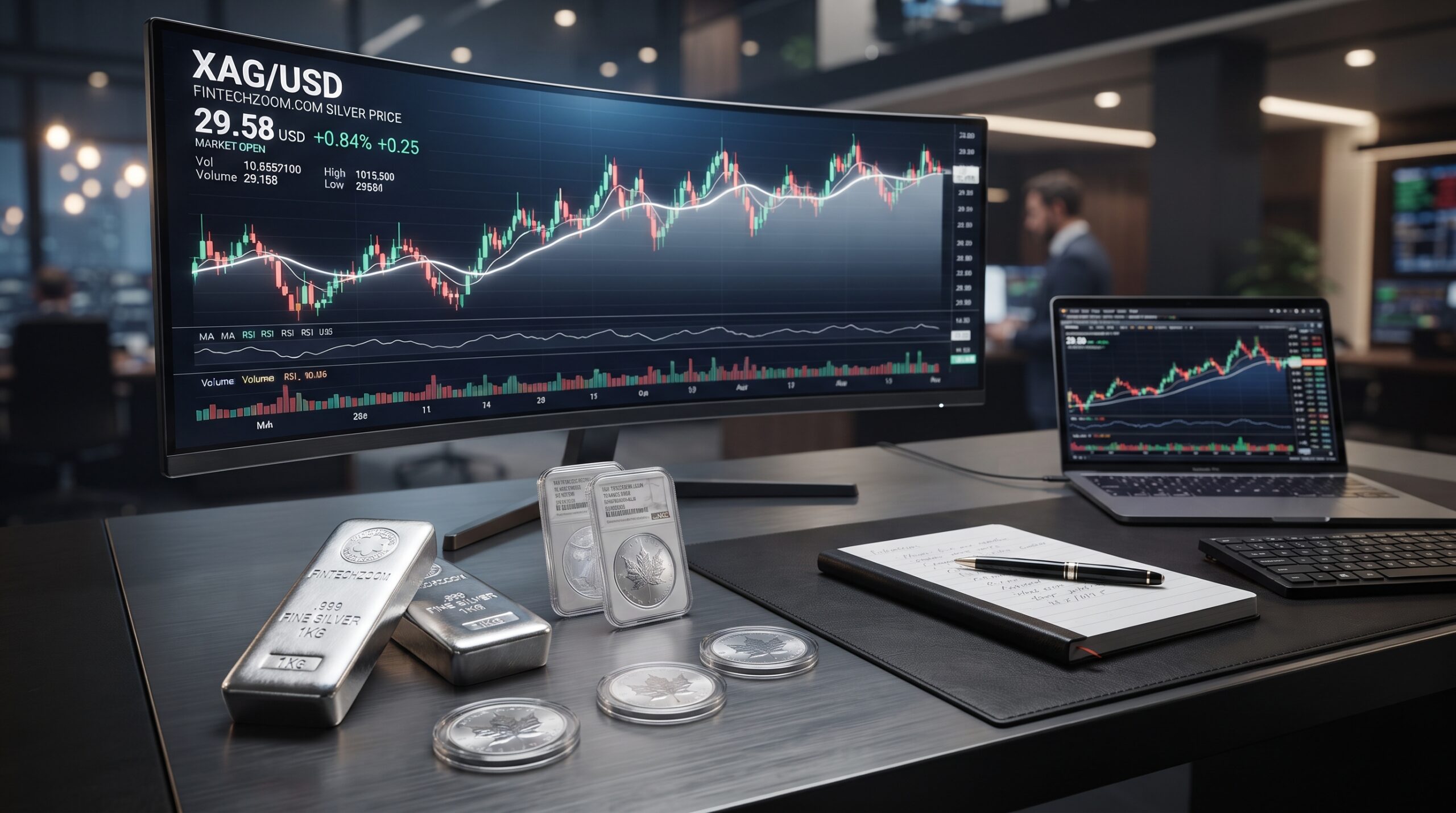
How to Read a Silver Price Chart
A silver price chart can look intimidating at first.
In reality, the basic concepts are straightforward.
Most charts show:
- Price on the vertical axis
- Time on the horizontal axis
- Price movement across a selected period
You might view silver over:
- One day
- One week
- One month
- Six months
- One year
- Five years
- Longer historical periods
The time frame matters enormously.
A chart showing a strong gain over five years can look completely different from a chart showing a decline over five days.
This is why investors should always ask:
What time period am I actually looking at?
Candlestick Charts and Silver
Many traders prefer candlestick charts because they provide more information than a simple line.
A single candlestick can show:
- Opening price
- Closing price
- Highest price
- Lowest price
The shape of the candle can reveal information about buying and selling pressure during a particular period.
For beginners, however, it is usually better to understand basic price trends before adding complicated technical indicators.
A chart full of indicators does not automatically produce better decisions.
Sometimes, simplicity is more powerful.
Silver Price FintechZoom and Historical Data
Historical data can help investors understand how silver behaved under different economic conditions.
Looking backward does not guarantee that you can predict the future.
Markets rarely repeat themselves perfectly.
However, historical charts can reveal important patterns.
For example, an investor might study how silver behaved during:
- Inflationary periods
- Recessions
- Financial crises
- Strong economic expansions
- Commodity booms
- Periods of rising interest rates
- Periods of falling interest rates
Historical context can transform a random-looking price chart into a meaningful story.
Why Silver Can Be More Volatile Than Gold
Silver is often described as the more volatile cousin of gold.
There is a reason for this.
Silver has a smaller market than gold and is influenced by both investment demand and industrial demand.
That combination can create larger price swings.
When investors become excited about silver, buying pressure can become intense.
When sentiment changes, the reverse can happen quickly.
This creates both opportunity and risk.
Someone attracted by silver’s potential upside must also be prepared for sharp declines.
Physical Silver vs. Paper Silver
Not everyone invests in silver in the same way.
Some people buy physical silver, while others use financial products that track silver prices.
Physical Silver
Physical silver can include:
- Coins
- Bars
- Rounds
- Collectible products
- Jewelry
The biggest attraction is simple: you own the metal itself.
However, physical silver also creates practical issues.
You need to consider storage, security, insurance, dealer premiums, authenticity, and the difference between buying and selling prices.
Financial Silver Investments
Other investors use financial instruments connected to silver.
These may provide exposure to silver prices without requiring the investor to store physical metal.
The structure, fees, risks, and tax treatment can vary significantly depending on the product and jurisdiction.
For this reason, investors should understand what they are actually buying rather than assuming that every silver-related investment works in the same way.
Is Silver a Good Investment?
There is no universal answer.
Silver can play a role in some investment strategies, but it also comes with meaningful risks.
One of its biggest attractions is diversification.
If an investor’s portfolio is heavily concentrated in one asset class, exposure to precious metals may provide another source of diversification.
Silver can also appeal to investors who believe industrial demand will remain strong over the long term.
But silver does not produce cash flow in the way a dividend-paying stock or interest-bearing bond can.
Its value depends heavily on what another buyer is willing to pay in the future.
That is why investors should consider silver as part of a broader strategy rather than treating it as a guaranteed path to wealth.
How Beginners Can Follow Silver Prices
If you are completely new to silver, do not make the mistake of checking the price once and immediately deciding whether to buy.
Instead, build a simple routine.
Start by checking the current spot price.
Then look at the daily and weekly trend.
After that, examine the longer-term chart.
Finally, ask what is happening in the broader economy.
Is the dollar strengthening?
Are interest-rate expectations changing?
Is industrial demand increasing?
Are investors becoming more nervous?
Are geopolitical risks rising?
These questions provide context that a single price number cannot provide.
Common Mistakes Silver Investors Make
Silver can be exciting, and excitement can sometimes lead to poor decisions.
Buying Because of Fear of Missing Out
When silver rises quickly, social media can become full of predictions.
People begin saying that prices are going even higher.
That can create FOMO.
Buying simply because everyone else appears to be buying is rarely a strong investment strategy.
Ignoring Premiums
A physical silver buyer may focus on the spot price while ignoring the premium charged by the dealer.
That can create an unrealistic expectation about potential returns.
Always calculate your true purchase cost.
Watching Only Short-Term Charts
A one-day move does not necessarily tell you where silver is heading.
Short-term volatility is normal.
Longer time frames can provide a more balanced perspective.
Using Too Much Leverage
Leverage can increase potential gains, but it can also magnify losses.
A small movement in silver can become a large financial loss when leverage is used aggressively.
Beginners should be especially careful.
Treating Forecasts as Guarantees
Silver forecasts are opinions based on assumptions.
No analyst can know exactly what the market will do tomorrow.
Forecasts can be useful for understanding possible scenarios, but they should never be treated as certainty.
Silver Price FintechZoom vs. Simply Searching for a Price
A basic search can give you a number.
But a dedicated financial resource can provide context around that number.
That difference matters.
Suppose silver rises sharply.
The number tells you that silver is higher.
A broader market analysis can help you ask why.
Was the dollar weaker?
Did investors become more optimistic?
Did industrial demand expectations change?
Did interest-rate expectations shift?
Was there a geopolitical event?
Understanding the reason behind a move is often more valuable than simply knowing that the move occurred.
What Makes Silver Different From Other Precious Metals?
Silver occupies a middle ground.
It has the historical appeal of a precious metal, but it also has a strong industrial identity.
That makes it different from gold.
Gold is often viewed primarily through the lens of wealth preservation, central-bank demand, currency concerns, and investor sentiment.
Silver has these characteristics too, but industrial consumption adds another layer.
This dual identity can make silver especially sensitive to changes in economic expectations.
If markets anticipate stronger industrial activity, silver may benefit.
If economic growth expectations deteriorate, industrial demand concerns may weigh on sentiment.
Silver Price Outlook: What Should Investors Watch?
Nobody can guarantee the future price of silver.
Instead of searching for one magical prediction, investors can monitor the major forces that could shape the market.
Watch:
Interest-rate expectations: Changes in monetary policy can affect precious metals and currencies.
The U.S. dollar: Currency movements can influence dollar-denominated commodities.
Industrial demand: Technology, electronics, solar energy, and manufacturing can affect silver consumption.
Mine production and supply: Changes in production can influence the balance between supply and demand.
Investor sentiment: Large shifts in investor positioning can create rapid price movements.
Global economic growth: Strong or weak economic conditions can influence both industrial and investment demand.
The future of silver will probably not be determined by one event.
It will be the result of many forces colliding at once.
How to Use Fintechzoom.com Silver Price Responsibly
A good silver-price resource should be used as an information tool, not as a substitute for independent thinking.
Use it to monitor prices.
Use charts to study trends.
Use historical data to understand market behavior.
Use financial news to identify potential catalysts.
But before making an investment, consider your own financial situation, risk tolerance, time horizon, and investment objectives.
The most dangerous investment decision is often the one made emotionally.
A rising market can create greed.
A falling market can create fear.
Neither emotion should control your strategy.
Final Thoughts on Fintechzoom.com Silver Price
Silver has survived centuries of economic change, yet it remains deeply connected to the modern world. From jewelry and investment bars to electronics and renewable-energy technologies, its story is much larger than the shiny metal sitting inside a vault.
Fintechzoom.com Silver Price can be useful for people who want to follow this story through price information, market charts, historical movements, and financial analysis.
The most important lesson is simple: do not look at the silver price in isolation.
Look at the forces behind it.
Understand spot pricing. Study charts. Watch the dollar. Follow interest rates. Pay attention to industrial demand. Consider supply. Think about investor sentiment. And above all, remember that silver can move quickly in both directions.
The market may sometimes feel like a quiet ocean, and at other times like a storm. A thoughtful investor does not try to control the waves. Instead, they learn to understand the tide.
That is ultimately the value of following Fintechzoom.com Silver Price: not simply knowing what silver costs today, but developing a clearer understanding of the forces that may shape its journey tomorrow.