


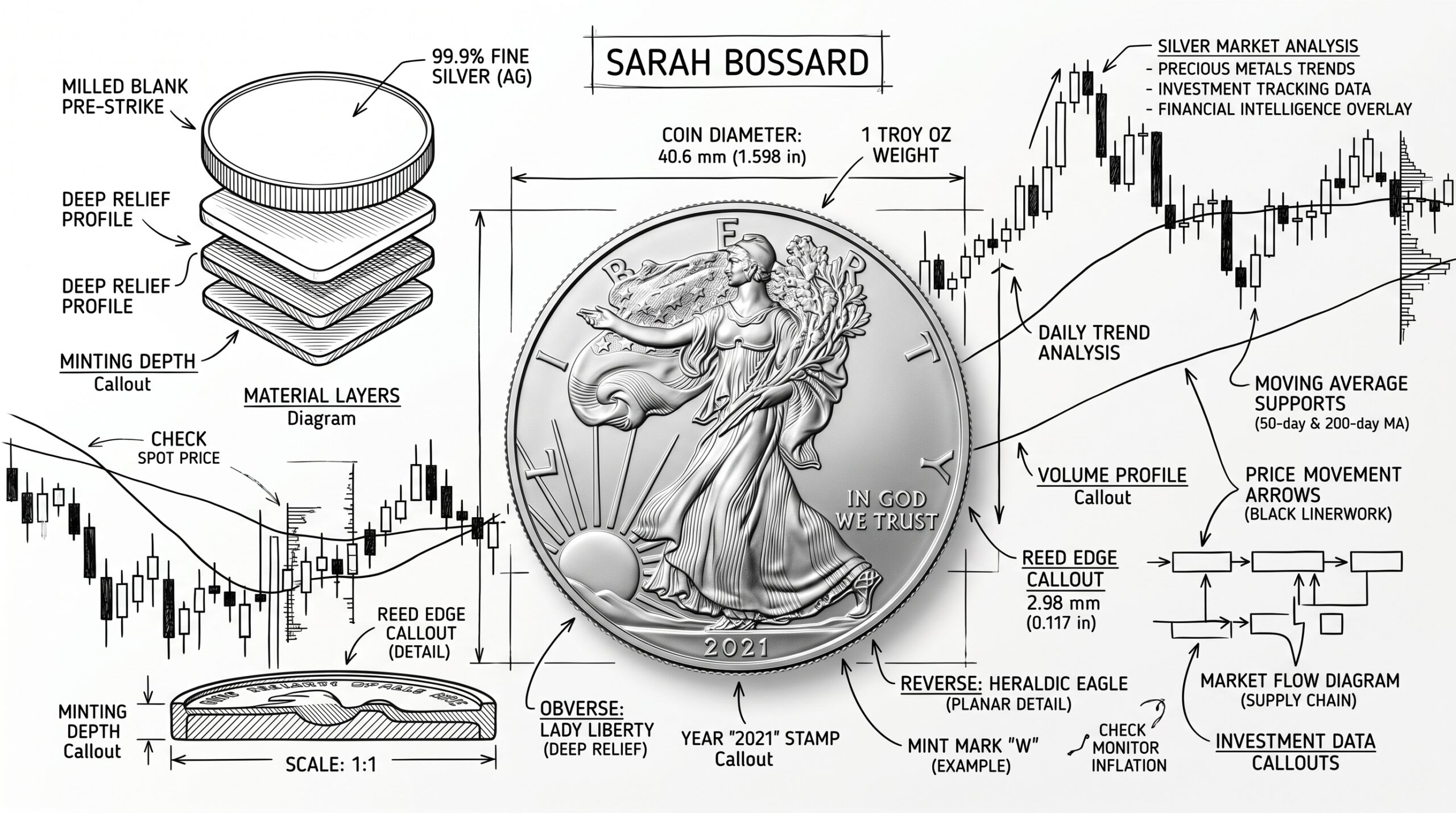
Silver is trading near $63–$65 per troy ounce as of June 2026 — down from an all-time high of $54.24 in October 2025 before climbing to even higher levels earlier this year. If you have been trying to make sense of those swings, the Fintechzoom.com silver price platform is one of the most accessible starting points available to retail investors. It aggregates live market data, interactive charts, price alerts, and editorial analysis in one place — without requiring a brokerage account to access it. This guide covers everything: what the platform does, what drives silver prices, how to read the data, and how to use it wisely.
What Is Fintechzoom.com and How Does It Cover Silver?
FintechZoom is a financial data and news aggregator that covers equities, commodities, forex, and crypto markets. Its silver section — often searched as the Fintechzoom.com silver price tool — functions as a real-time commodity tracker with layered analytical features built on top.
The platform pulls live spot price data for XAG/USD (silver priced in US dollars per troy ounce), the standard global benchmark. It displays this alongside historical price charts, technical overlays, and market commentary written by its editorial team.
According to data from the Silver Institute’s World Silver Survey 2026, silver prices averaged just over $40 per ounce across all of 2025 — a 42% year-on-year increase — before climbing dramatically into 2026, making reliable, real-time tracking more important than ever.
Key Features of the Fintechzoom.com Silver Price Tool
The platform offers several features that go beyond a simple price ticker:
- Live spot price feed — XAG/USD updated continuously during market hours, reflecting the London Bullion Market Association (LBMA) benchmark and futures-derived pricing
- Interactive historical charts — zoom ranges from 1 day to 10+ years, allowing comparison of silver’s current level against major market cycles
- Technical indicator overlays — RSI, MACD, and Bollinger Bands can be layered onto charts for traders who use technical analysis
- Asset comparison — silver can be plotted alongside gold, the S&P 500, or other commodities to assess relative performance
- Price alerts — users can set threshold notifications so they are informed when silver crosses a specific level without needing to monitor the screen continuously
- Market news feed — curated articles on macro drivers including Federal Reserve policy, geopolitical events, and industrial demand shifts
How to Use the Platform Step by Step
Getting useful information from the Fintechzoom.com silver price section takes less than five minutes once you understand the layout:
- Navigate to the Silver Price section from FintechZoom’s main commodities menu
- Note the live spot price and its percentage change from the previous close
- Switch the chart to your preferred timeframe — weekly for traders, yearly for investors
- Enable one or two technical indicators if you want to assess momentum
- Read the accompanying editorial note for context on what is driving the day’s price action
- Set a price alert if you are waiting for a specific entry or exit level
The platform does not require registration for basic use, though price alerts may require a free account.
What the Fintechzoom.com Silver Price Data Actually Shows Right Now
Silver’s Price in June 2026
As of June 10–11, 2026, silver spot (XAG/USD) is trading in the $63–$65 per troy ounce range, according to data from Trading Economics, CNBC, and FXStreet. Silver traded at approximately $63.99 per troy ounce, down from $65.37 the previous day, with the metal having declined around 9.98% since the start of 2026.
That pullback follows an extraordinary run. Silver prices averaged just over $40 per ounce across all of 2025, representing a 42% year-on-year increase, before climbing to even higher levels in early 2026. Anyone tracking the Fintechzoom.com silver price charts over that period would have seen one of the most dramatic multi-month rallies in the metal’s modern history.
Why Prices Have Pulled Back in Mid-2026
The June 2026 decline reflects a specific combination of pressures. Silver retreated toward $63 per ounce as investors processed new US producer price data, a European Central Bank interest rate increase, and worsening Middle East tensions — with US producer prices climbing 6.5% year-over-year in May, the sharpest rise since November 2022.
Rising real yields and rate-hike expectations typically weigh on non-yielding assets like silver. The gold/silver ratio widened to 65.0, reflecting silver’s dual exposure to both monetary policy headwinds and industrial demand uncertainty. Understanding this ratio — how many ounces of silver it takes to buy one ounce of gold — is a key analytical tool for timing silver positions, and it is one metric you can track directly through the FintechZoom interface.
What Drives the Silver Price: The Fundamentals Behind the Numbers
Industrial Demand: The Structural Story
Silver is not purely a monetary metal. Roughly 61% of total global silver demand now comes from industrial applications — and that figure has been rising for a decade. Silver industrial demand hit a record 680.5 million ounces in 2024, the fourth consecutive annual record, driven by photovoltaics, electronics, and automotive applications.
The three biggest industrial drivers heading into 2026 are:
- Solar panels — Each solar cell uses silver paste for electrical conductivity. Solar’s share of silver’s industrial demand grew from 11% in 2014 to 29% in 2024 — nearly tripling in a decade.
- Electronics and 5G — Smartphones, advanced semiconductors, and 5G base stations all depend on silver’s unmatched conductivity. The electronics and 5G sector consumes approximately 240 million ounces annually, with growth rates of 8–12% projected.
- Electric vehicles (EVs) — A single EV uses up to 50 grams of silver, roughly twice as much as a conventional car, in battery management systems, power electronics, and charging contacts.
A Silver Institute report produced by Oxford Economics confirmed that solar energy, automotive EVs and their infrastructure, and data centers powered by AI will continue driving industrial silver demand higher through 2030.
Investment Demand and Monetary Role
Silver also benefits from investment demand, particularly when real interest rates are low or negative and when geopolitical uncertainty is elevated. Exchange-traded products (ETPs) backed by physical silver absorbed significant inflows in 2025, pushing global ETP holdings close to all-time highs.
Historically, silver has outperformed gold during precious metals bull markets — but it also falls harder during corrections. That amplified volatility is visible in the Fintechzoom.com silver price charts and is a key characteristic investors need to understand before committing capital.
Supply Constraints
Supply has not kept pace with demand. The overall silver market has run a structural supply deficit for five consecutive years, meaning annual demand has exceeded mine supply every year since 2021.
Why can’t supply simply scale up? Several reasons:
- 72% of silver is produced as a byproduct of mining other metals (copper, lead, zinc), so production cannot easily be increased in response to silver’s price alone
- New dedicated silver mines take 5–10 years from discovery to production
- Global silver mine production rose significantly in 2025, supported by project ramp-ups in Latin America, and recycling reached a 13-year high of 197.6 million ounces — but neither was sufficient to close the supply gap.
This persistent deficit is the single most important structural factor supporting silver’s price over the medium and long term.
How to Interpret Fintechzoom.com Silver Price Charts
Reading the Spot Price vs. Futures Price
The price displayed on FintechZoom is typically the spot price — what silver would cost to buy and take delivery of right now. Futures prices, which appear on CME Group markets, represent the expected price at a future delivery date and are usually slightly higher (a condition called “contango”) due to storage and financing costs.
For most retail investors, the spot price is the relevant figure. It is what gold and silver dealers quote when you buy physical coins or bars, and it is the reference point for silver ETFs like SLV.
Technical Indicators Worth Watching
If you enable overlays on the FintechZoom charts, three indicators are particularly useful for silver:
- RSI (Relative Strength Index) — readings above 70 suggest the metal may be overbought; below 30 suggests oversold conditions. Silver’s RSI was elevated through much of early 2026 before the recent correction.
- 200-day moving average — the most commonly watched long-term trend line. Silver trading above its 200-day MA is generally interpreted as a bullish structural signal.
- Bollinger Bands — useful for identifying when silver’s volatility is compressing before a major directional move. Band squeezes in silver often precede sharp rallies or declines.
None of these are predictive on their own. They are most useful when they align — for example, when silver is near the lower Bollinger Band, oversold on RSI, and holding above its 200-day MA simultaneously.
The Gold-to-Silver Ratio
This ratio — currently around 65 — tells you how many ounces of silver you would need to buy one ounce of gold. Historically, the ratio has ranged from 15 (in the 19th century, when both were monetary standards) to over 120 (during the COVID crash of March 2020). A high ratio generally suggests silver is cheap relative to gold; a declining ratio suggests silver is outperforming.
FintechZoom’s comparison chart feature allows you to plot silver against gold directly, making it simple to calculate this ratio visually over any timeframe you choose.
How to Invest in Silver: Options Explained
Once the Fintechzoom.com silver price data has informed your view, you have several ways to actually take a position:
Physical silver — coins (such as American Eagles or Canadian Maple Leafs) and bars offer direct ownership with no counterparty risk, but involve storage costs and dealer premiums above spot price, typically ranging from 3% to 8%.
Silver ETFs — funds like iShares Silver Trust (SLV) or Aberdeen Standard Physical Silver Shares ETF (SIVR) hold physical silver and trade on stock exchanges. They are the most convenient route for investors with standard brokerage accounts.
Silver mining stocks — companies like Pan American Silver, First Majestic Silver, and Wheaton Precious Metals offer leveraged exposure to silver prices. When silver rises 20%, a well-run miner might rise 40–60% — but the downside is equally amplified.
Silver futures — traded on the CME’s COMEX division, futures offer the highest leverage and most precise price exposure, but require margin accounts and active management. Not appropriate for most retail investors.
Silver CFDs — contracts for difference are offered by many online brokers for speculative short-term trading. High risk, not suitable as a long-term holding.
For most individual investors, a combination of physical coins and a silver ETF covers the bases — physical for genuine crisis protection, the ETF for liquidity and ease of trading.
Frequently Asked Questions About Fintechzoom.com Silver Price
What does Fintechzoom.com show for the silver price?
The Fintechzoom.com silver price section displays the live spot price of silver in US dollars per troy ounce (XAG/USD), updated continuously during global market hours. It also provides interactive historical charts with technical indicator overlays, price comparison tools against gold and equities, configurable price alerts, and market analysis articles covering the macro and industrial factors behind silver’s daily price movements. No brokerage account is required for basic access.
Why is the silver price moving so much in 2026?
Silver in 2026 has been caught between two opposing forces. On the bullish side, structural supply deficits, strong investment demand, and silver’s role in green energy infrastructure pushed prices to historic highs in early 2026. On the bearish side, rising US interest rate expectations, elevated inflation, and geopolitical risk around the Middle East have periodically triggered sharp selloffs. Silver’s relatively small market size makes it inherently more volatile than gold, amplifying both the gains and the losses.
Is silver a good investment to track on FintechZoom right now?
Silver remains one of the most watched commodities on financial platforms in 2026 for good reason — it is at historically elevated price levels, the supply-demand picture remains structurally tight, and its dual role as both an industrial input and a monetary safe haven creates genuine complexity for investors to navigate. Whether silver is a good investment for you specifically depends on your risk tolerance, time horizon, and portfolio context. FintechZoom provides the data to inform that decision; it does not make the decision for you.
What is the gold-to-silver ratio and where can I track it?
The gold-to-silver ratio measures how many ounces of silver are required to purchase one ounce of gold. It currently sits near 65, calculated by dividing gold’s spot price (~$4,160) by silver’s (~$64). Historically, a ratio above 80 has signaled that silver is cheap relative to gold; a ratio below 40 has indicated the opposite. FintechZoom’s chart comparison tool allows you to track this ratio visually by plotting XAU/USD against XAG/USD across any timeframe.
Does FintechZoom provide silver price forecasts?
FintechZoom publishes editorial forecasts and analyst consensus views as part of its market commentary, drawing on projections from institutions such as Metals Focus, the Silver Institute, and major bank commodity desks. These are informed views based on supply-demand modeling and macroeconomic scenarios — not guaranteed predictions. For context, Metals Focus projected in the World Silver Survey 2026 that the global silver market would run a structural deficit for a fifth consecutive year in 2025, a data point that underpins many bullish long-term forecasts.
Conclusion
Silver’s price in mid-2026 — hovering around $63–$65 per troy ounce after extraordinary gains over the prior 18 months — reflects a market at a genuine crossroads. Structural demand from solar panels, EVs, AI data centers, and electronics is real and well-documented. So is the persistent supply deficit that has run for five consecutive years. At the same time, rising interest rates and geopolitical disruptions have introduced meaningful short-term headwinds.
The Fintechzoom.com silver price platform gives you the tools to track all of these dynamics in real time: live spot prices, technical charts, historical context, and editorial commentary that translates macro events into market implications. For investors who want to understand silver — not just follow a number — it is a genuinely useful starting point.
The next step is yours. Head to FintechZoom’s silver section, set a price alert at a level that matters to you, and spend 15 minutes with the historical chart before making any investment decisions. The data is there; the analysis above gives you the framework to read it clearly.